




“In an Age of Uncertainty, the Bank of Korea Should Communicate More with Markets” [ESF2026]
[Sub-Title]
Day 2 of the 17th Edaily Strategy Forum
Presentation by Jin-il Kim, Member of the Monetary Policy Board, Bank of Korea
“A 3-month forecast is no longer sufficient... the market demands Longer-Term Interest Rate Information”
“Need to Communicate Not Only Individual Forecasts but Also the Range of Views among Policymakers.”
[Edaily By Reporter Da-won Lee, Yeon-seo Kim and Ju-hwan Kim] As domestic and global economic uncertainty continues to intensify, experts have emphasized the importance of effective communication by central banks in monetary policy. Central banks should explain not only the projected interest rate path but also the uncertainty embedded within those forecasts.
|
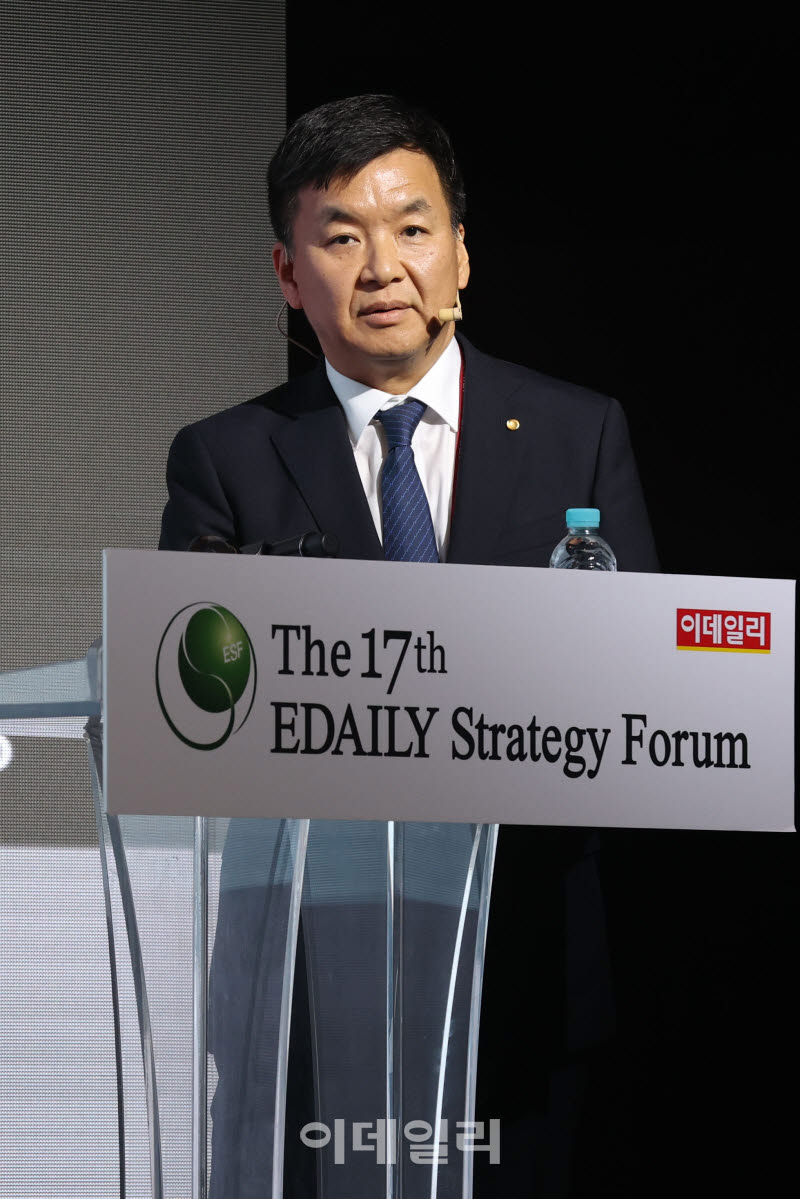
He diagnosed that the global economy is currently facing far greater uncertainty than in the past, driven by a combination of geopolitical conflicts, shifts in fiscal policy, and external economic shocks, making it increasingly difficult even to forecast the economy.
“Policy communication is a double-edged sword even in normal times,” He noted, “While it helps shape market expectations, since economic conditions are continuing to change, the central banks can be provenwrong, which may lead to their credibility risks.”
Despite those challenges, he observed many central banks are shifting toward providing conditional forecasts and alternative scenarios. The Bank of Korea has also been increasing its policy communication by introducing forward guidance (pre-announcing the direction of policy) in October 2022, increasing its policy communication by presenting conditional interest-rate outlook over the following 3 months.
Kim evaluated this positively, saying, “At the time of zero interest rates, discussing future policy direction was virtually the only available policy tool. Forward guidance has proven highly effective in shaping market expectations and reducing financial market volatility.”
However, he pointed out limitations: “By human nature, people tend to interpret conditional promises as unconditional ones. Even when central banks speak conditionally, markets and the media often treat them as firm commitments.” Ultimately, this may end up constraining the central bank’s own future actions and reduce policy flexibility.
The Bank of Korea‘s recent introduction of the Dot Plot is an extension of these efforts. Starting this year, the Bank began releasing a Dot Plot for the base rate over the next 6 months. Kim explained, “We asked each member to submit 3 dots instead of 1. With 7 members, this creates 21 dots, allowing us to express the baseline scenario along with various possibilities.”
He explained the background: “The previous 3-month interest rate forecast had clear limitations. The market felt that 3 months was too short and wanted to know the outlook for a longer period.” There were also demands for information on probability distributions, for example, whether the likelihood of a rate cut or hike was 50% or only 10%.
Still, he stressed that the introduction of the dot plot itself is not the goal. Kim said, “Going forward, how to communicate uncertainty will become even more important,” adding, “We need toconsider how to explain probabilities such as 50% or 10%, and how to communicate not only individual forecasts but also the distribution of views among committee members.”
He concluded by emphasizing, “Perfect transparency that satisfies everyone does not exist. Nevertheless, central banks must continue striving to achieve an appropriate level of transparency within certain limits and effectively convey uncertainty.”






!["숨 막혀" 돈가스 먹다 의식 흐려진 5살…엄마가 도움 요청하자 [따전소]](https://image.edaily.co.kr/images/vision/files/NP/S/2026/10/PS26100701344t.jpg)