This article was released as Pharm Edaily Premium Content on March 9, 2026, at 8:00 AM.
[Yu Jin-hee, Edaily Reporter] On the 6th despite the overall dampened investor sentiment caused by geopolitical risks, the domestic bio sector saw a strong influx of capital into stocks deemed undervalued relative to their intrinsic value.
In particular "substance heavy" companies those recently acquired by stable parent groups or on the verge of disclosing global clinical data dominated the Top 20 gainers list signaling a resurgence for the bio sector.
|

Woojung Bio Joins Kolmar Group: A First-Generation Bio Venture’s Grand Revival
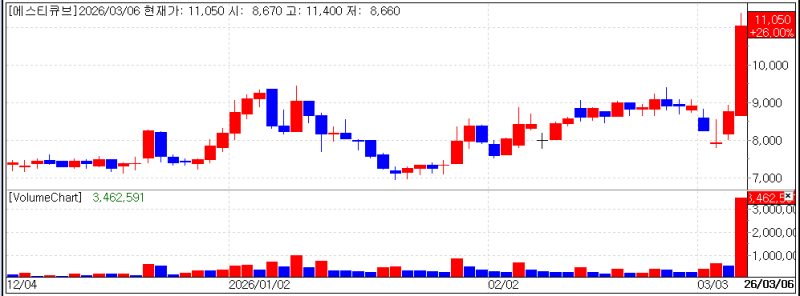
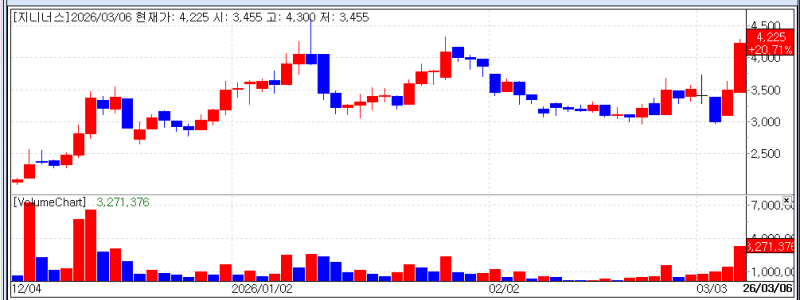
According to KG Zeroin MP Doctor, Woojung Bio, STCube and Geninus all secured spots on the domestic stock market’s "Top 20 Gainers" list. Their share prices surged by 29.93% (closing at 2,735 won), 26.00% (11,050 won) and 20.71% (4,225 won), respectively. This rally is seen as more than just a technical rebound it reflects the market’s high expectations for a complete structural transformation of these firms.
Woojung Bio hit the upper circuit limit (+29.93%) immediately after the market opened on the 6th. The primary catalyst was the recent announcement that Kolmar Holdings would acquire a controlling stake in the company. Woojung Bio decided to issue 35 billion won worth of third party allotted convertible bonds (CB) to Kolmar Holdings.
Through this agreement, Kolmar Holdings is set to secure a 47.2% stake, becoming the largest shareholder. Beyond a mere capital injection, the market cheered the fact that this firstgeneration bio venture which had been struggling with liquidity and a leadership vacuum is now integrated into the vast network of the Kolmar Group, a powerhouse in cosmetics and pharmaceuticals.
Despite owning a state-of-the-art infrastructure the largest private "New Drug Cluster" in Korea completed in 2021 Woojung Bio had fallen into a "winner's curse" due to a slump in the non clinical CRO market, 65 billion won in debt and high fixed costs. The company faced further uncertainty following the passing of founder Chun Byung-nyun last year.
However, the entry of Kolmar Holdings has completely shifted the narrative. Kolmar Group has a proven track record in bio M&A, including the successful acquisition of HK inno.N (formerly CJ Healthcare). Kolmar plans to maintain Woojung Bio’s core businesses such as non clinical CRO and the "Lab Cloud" project while maximizing R&D efficiency across the group.
"We will continue Woojung Bio’s existing businesses and leverage Kolmar Group’s global network to significantly enhance its operational capabilities," stated a representative from Kolmar Holdings.
|
STCube Bets on the Next Paradigm of Immunotherapy
STCube also captured investor attention with a 26% price jump. The core of this rally lies in the re-evaluation of its BTN1A1 inhibitor, Nelmastobart (hSTC810).
STCube is targeting the "refractory patient group" those who do not respond to existing PD-L1 inhibitors. Data recently presented at the ASCO Gastrointestinal (GI) Cancers Symposium 2026 showed that Nelmastobart was significantly effective in colorectal cancer patients where BTN1A1 and the specific biomarker YAP1 were co expressed. This suggests that STCube has successfully identified and blocked a new pathway that cancer cells use to evade the immune system.
Market analysts believe STCube is moving beyond drug development to set a "new standard" in the immunotherapy market. Furthermore, its strong liquidity (approximately 73.3 billion won as of Q3 2025) provides the stability needed to continue large-scale clinical trials aimed at global licensing-out (L/O) deals.
Experts anticipate that the interim results of the Phase 2 trial for metastatic colorectal cancer, expected in the second half of the year, will be the "main event" for the company’s valuation. With global big pharma hungry for new mechanisms to overcome the limitations of current treatments a multi billion dollar deal is being cautiously discussed.
|
Geninus Maps the Future of Cancer Treatment with Spatial Omics
Geninus gained market favor as its "Spatial Omics" technology which simultaneously analyzes the genetic information and the physical location of cancer tissue was spotlighted.
While traditional analysis involves grinding tissue and looking at average values Geninus's Spatial Omics maintains the tissue in a slide format to precisely analyze where immune cells are located and what state they are in.
Park Woong-yang, CEO of Geninus, emphasized in a recent interview that "the state of T-cells is more important than their quantity." He noted that Spatial Omics allows for the design of new immunotherapies that can recover or regulate "exhausted" T-cells.
This technological prowess is already yielding global results. Geninus is participating in the "MONSTAR-3" project led by the National Cancer Center Japan. It has also signed software supply contracts (for Space Insight and IntelliMed) with major domestic and international pharmaceutical companies, including ABL Bio, as well as medical institutions in Thailand and Japan.
"We are currently in negotiations with several global pharmaceutical companies including those in Japan" a Geninus official said. "We are doing our best to announce additional contracts in the near future.“