이 기사는 2026년09월14일 08시26분에 팜이데일리 프리미엄 콘텐츠로 선공개 되었습니다.
[Kim Sungjin, Edaily Reporter] Korean pharmaceutical and biotech stocks showed mixed performances on Sept. 11, with KM Pharmaceutical and BL Pharmtech both hitting their daily upper price limits. KM Pharmaceutical, in particular, surged despite news that it had received a delisting decision, creating an unusual situation in which the stock rallied after the company was effectively put on the path to being removed from the market.
SK Biopharm, meanwhile, fell after the U.S. Food and Drug Administration (FDA) placed a partial clinical hold on the U.S. Phase 2/3 clinical trials of Ophakalim (BHV-7000), an epilepsy drug candidate that the company plans to acquire from Biohaven.
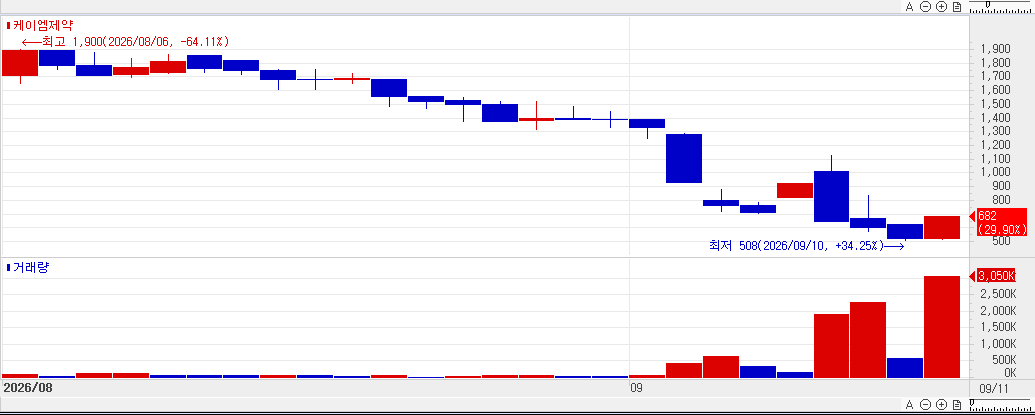
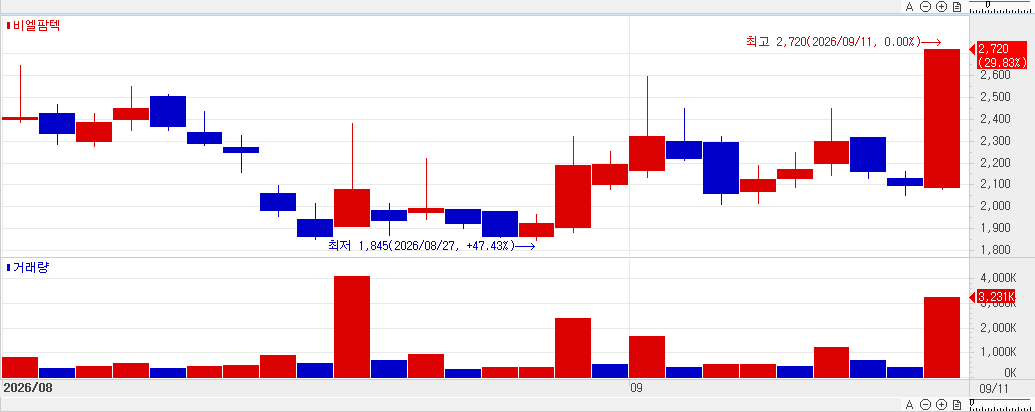
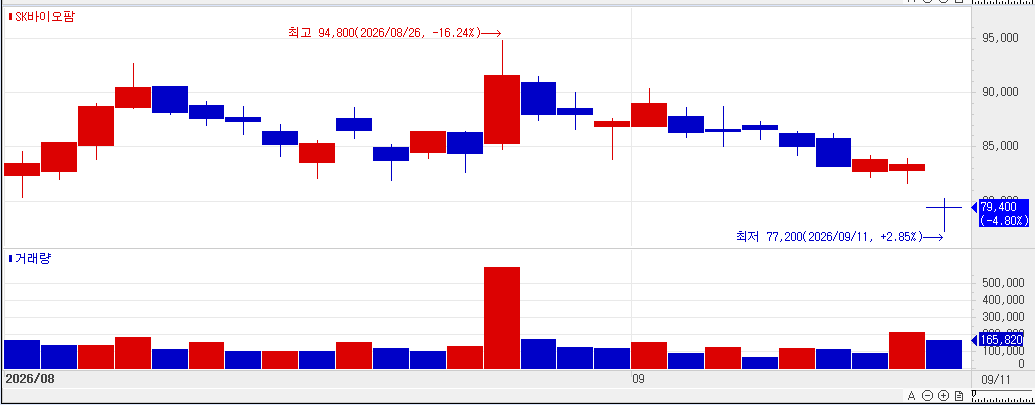
According to MP DOCTOR, formerly known as MarketPoint, operated by KG Zeroin, KM Pharmaceutical shares closed at 682 won, up the daily limit. BL Pharmtech also surged 29.83% to close at 2,720 won. SK Biopharm fell 4.8% to 79,400 won.
KM Pharmaceutical Surges Despite Delisting Decision
KM Pharmaceutical shares jumped immediately after the market opened and remained at the daily upper price limit from around 12:30 p.m. through the close.
The stock has shown extreme volatility in recent sessions. Shares stood at 1,330 won on Sept. 1 before plunging to 931 won after hitting the daily lower price limit on Sept. 2. They fell further to 710 won on Sept. 4, marking a decline of more than 46% in just three trading sessions. The stock then rebounded sharply, hitting the upper price limit on Sept. 7.
|
The sharp move on Sept. 11 came after Edaily's premium pharmaceutical and biotech content platform PharmEdaily reported exclusively that KM Pharmaceutical had become the first Korean biotech company to face delisting due to insufficient market capitalization.
According to the report, the Korea Exchange's KOSDAQ Market Division finalized the delisting process after KM Pharmaceutical failed to meet the minimum market capitalization requirement. The company is scheduled to enter liquidation trading next week.
Investors are being urged to exercise caution. KM Pharmaceutical has a market capitalization of less than 5 billion won, making it a micro-cap stock whose price can be moved significantly with relatively small amounts of capital. Speculative buying ahead of liquidation trading cannot be ruled out, while some shareholders may also attempt to push up the stock price in hopes of preventing the delisting.
KM Pharmaceutical's exit from the KOSDAQ market marks the first delisting case in Korea's pharmaceutical and biotech sector. In July, financial authorities raised the KOSDAQ's minimum market capitalization requirement from 15 billion won to 20 billion won as part of efforts to accelerate the removal of financially distressed companies. Companies have since begun facing delisting procedures under the revised rules.
Founded in 2001, KM Pharmaceutical built its business around children's oral-care products, most notably toothpaste featuring the popular Korean children's character Pororo. The company has since expanded into masks, hand sanitizers and tissues, while broadening its business into skincare and scalp-care products after starting operations at its second plant in Pyeongtaek, Gyeonggi Province.
However, the company has faced growing difficulties in recent years as sales declined and operating losses widened. Revenue, which exceeded 20 billion won in 2021, fell to around 16 billion won last year, while the company has remained in the red since 2022.
BL Pharmtech Hits Upper Limit on ML301 Licensing Expectations
BL Pharmtech also hit the daily upper price limit on Sept. 11.
The stock had traded in the 300-won range at the beginning of the year, but gained significant attention on the KOSDAQ after hitting the upper price limit 12 times in January and February alone. Shares reached as high as 8,150 won on Feb. 10.
|
BL Pharmtech operates a health functional food business as well as an oncology drug development business based on molecular glue technology and targeted protein degradation (TPD). Its drug development business has drawn particular attention from investors.
The company's key pipeline is ML301, an investigational anticancer drug candidate targeting difficult-to-treat solid tumors.
BL Pharmtech is currently exploring potential licensing deals for ML301 with domestic and overseas pharmaceutical companies. ML301 is also reportedly capable of being developed not only as a standalone drug but also as an antibody-conjugated therapy.
The stock's sharp rise on Sept. 11 was attributed to growing expectations of a potential licensing deal involving ML301.
SK Biopharm Falls 4.8% on Ophakalim Clinical Hold
SK Biopharm shares fell 4.8% to 79,400 won. The stock dropped as low as 77,200 won during the session before recovering to the 79,000-won range.
The decline came after the FDA placed a partial clinical hold on the U.S. Phase 2/3 development program for Ophakalim (BHV-7000), an epilepsy drug candidate that SK Biopharm plans to acquire from Biohaven.
|
SK Biopharm signed a global exclusive licensing agreement with Biohaven for Ophakalim worth up to $795 million. The deal is the largest licensing transaction involving a drug candidate from an overseas company by a Korean pharmaceutical or biotech company.
At an online briefing held Thursday morning, SK Biopharm said Biohaven plans to submit additional nonclinical data to the FDA as early as the end of September and expressed expectations that the clinical hold could be lifted between October and November.
The clinical hold was triggered by a nonclinical toxicity finding involving a specific metabolite of Ophakalim. Toxicity was observed when the metabolite was administered to rats. The FDA requested additional data to determine whether the finding is specific to rodents or could also be relevant to humans.
SK Biopharm said it had been aware of the issue before signing the agreement and had conducted its own risk assessment before proceeding with the deal. More than 1,200 patients have participated in clinical trials of Ophakalim to date, and no adverse events directly associated with the nonclinical toxicity finding have been identified.
Of the ongoing Phase 2/3 trials, RISE2 and RISE3, patient enrollment for RISE3 has already been completed. SK Biopharm expects to maintain its plan to announce topline results in the second half of this year.