이 기사는 2026년10월07일 07시35분에 팜이데일리 프리미엄 콘텐츠로 선공개 되었습니다.
[Sungjin Kim, Edaily Reporter] Shares of affiliates of HLB surged across the board on Oct. 6 after the U.S. Food and Drug Administration (FDA) approved an anticancer drug developed by the Korean group, while Samchundang Pharm continued its rally for a fifth consecutive trading session.
Shares of HLB Pharmaceutical and HLB BioStep hit the daily upper limit, while Samchundang Pharm has drawn attention after its stock jumped for five straight sessions following a sharp decline triggered by delays in key pipeline milestones and controversies surrounding corporate disclosures.
HLB Affiliates Hit Upper Limit on Lyrfiktu Approval; Rivoceranib Next in Focus
According to KG Zeroin's MP Doctor, shares of HLB Pharmaceutical rose KRW 3,000, or 29.97%, from the previous session to hit the daily upper limit. The stock had previously hit the upper limit for two consecutive sessions following news of the U.S. FDA's approval of HLB's biliary tract cancer drug Lyrfiktu (LYRFIGTU), before retreating. It surged again on Tuesday.
HLB BioStep, another affiliate, also hit the upper limit, rising KRW 860, or 29.91%, to KRW 3,735. Other major HLB affiliates also posted sharp gains, including HLB Life Science (+25.03%), HLB Global (+16.88%), HLB (+16.81%) and HLB Therapeutics (+15.99%).
|

The rally in HLB shares is widely attributed to the FDA approval of Lyrfiktu. The drug was licensed to HLB's U.S. subsidiary Elevar Therapeutics by Relay Therapeutics in December 2024. Elevar plans to launch the drug in the U.S. in the fourth quarter of this year.
Lyrfiktu is the first anticancer drug developed by a Korean company to receive FDA approval. HLB has drawn considerable attention from the industry for independently pursuing the drug's development and regulatory approval after securing its rights. The approval has also been viewed as opening a new chapter for Korea's innovative drug development industry.
Following Lyrfiktu's successful approval, market attention is now turning to HLB's next potential oncology drug. Rivoceranib, which HLB has been developing for about two decades, is widely regarded as one of the group's leading candidates.
Rivoceranib is an investigational treatment for liver cancer that HLB has spent roughly 20 years developing. However, the program has faced significant uncertainty after receiving three complete response letters (CRLs) from the FDA. The third CRL was partly attributed to deficiencies identified during the FDA's cGMP inspection of manufacturing facilities operated by Hengrui Pharmaceuticals, HLB's Chinese partner, covering both active pharmaceutical ingredients and finished drug products.
Concerns over the program have recently eased somewhat. HLB said Tuesday that the FDA classified its routine cGMP inspection of the manufacturing facility for rivoceranib's finished drug product as Voluntary Action Indicated (VAI). Earlier, on Oct. 3, Hengrui Pharmaceuticals received an Establishment Inspection Report following the inspection.
VAI is an FDA classification indicating that inspection findings were identified but that the company can address them voluntarily without the need for formal regulatory action. Elevar is working with Hengrui to finalize the materials required to resubmit its New Drug Application (NDA) for liver cancer.
An HLB official said the VAI classification resulted from Hengrui's company-wide efforts to address the inspection findings, adding that Elevar would work closely with Hengrui to complete preparations for the NDA resubmission and respond to the FDA review without delay.
Samchundang Pharma Up 49% in Five Sessions; Company Says No Clear Catalyst
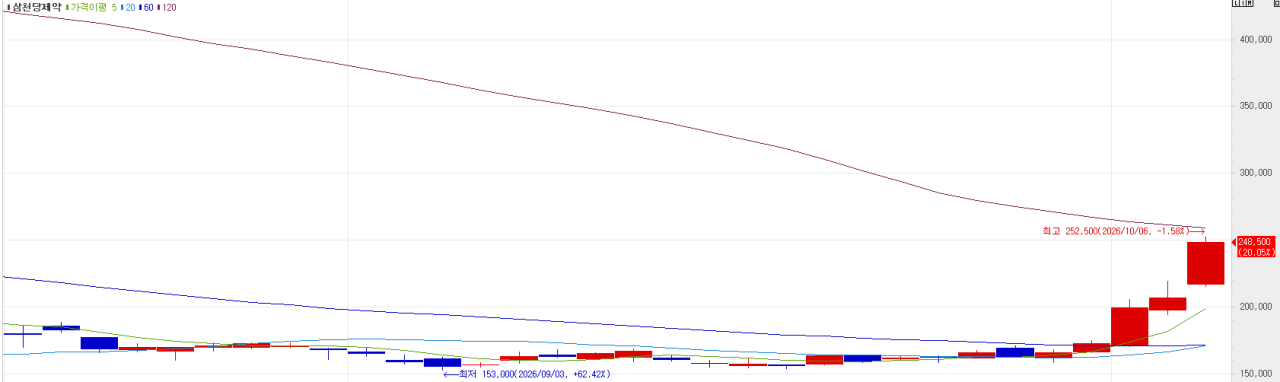
Samchundang Pharm's sharp rise was another notable development in the biotech sector. According to KG Zeroin's MP Doctor, its shares rose KRW 34,500, or 16.67%, from the previous session to KRW 241,500.
The stock has gained for five consecutive trading sessions. From KRW 162,300 on Sept. 28, shares have surged 48.8% in just five sessions.
Samchundang Pharm recently announced plans to expand its macular degeneration treatment business with Canadian partner Apotex from a single biosimilar product to a broader portfolio. The company plans to add new treatments following the commercialization of its Eylea biosimilar SCD411 in Canada.
|
The company is also making its first solo appearance at CPHI Worldwide, a global pharmaceutical industry exhibition being held in Milan from Oct. 6. Samchundang Pharm plans to showcase its pipeline, including oral insulin, oral GLP-1 drugs, long-acting injectable products and immuno-oncology biosimilars.
The company, however, said it was not aware of any particular factor that could explain the recent stock rally.
Alteogen Raises KRW 200 Billion, Merges Subsidiary; Stock Stays Muted
|
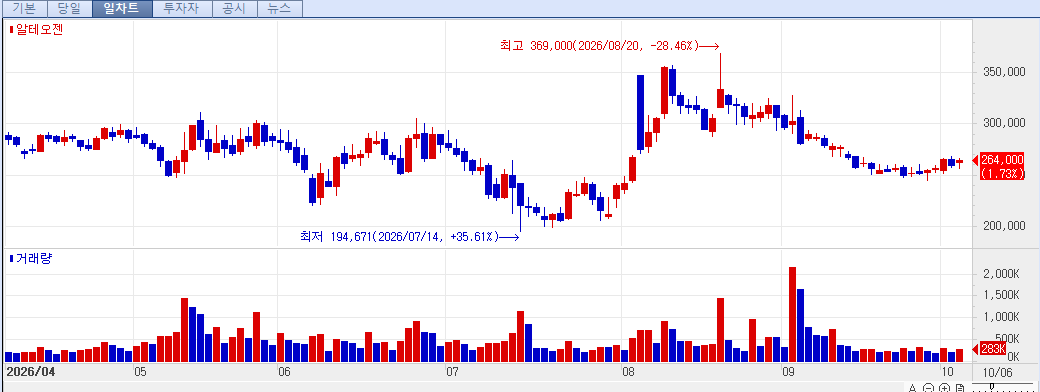
Alteogen announced plans to raise KRW 200 billion from the National Growth Fund and Skylake Equity Partners and merge its subsidiary, but the stock showed little reaction. According to KG Zeroin’s MP DOCTOR, Alteogen shares were trading 4,500 won, or 1.73%, higher than the previous session in the after-hours market following the close.
Alteogen said it will issue KRW 200 billion worth of preferred shares to SkyAlt, an investment vehicle established through a matching investment by the National Growth Fund and Skylake. The financing will consist of KRW 100 billion in convertible preferred shares (CPS) and KRW 100 billion in redeemable convertible preferred shares (RCPS).
The company plans to use the proceeds to expand production capacity based on the performance of ALT-B4 while acquiring new pipelines to diversify its business portfolio. ALT-B4 is the key ingredient in Alteogen’s Hybrozyme platform, which is designed to convert intravenous drugs into subcutaneous formulations. Merck & Co.’s subcutaneous formulation of Keytruda, which incorporates ALT-B4, has received regulatory approvals and launched in the United States, Europe, Canada, South Korea and Japan.
Alteogen also announced plans to absorb its subsidiary Alteogen Biologics through a small-scale merger. Alteogen will remain the surviving company, while Alteogen Biologics will be dissolved following the merger.
Under the existing structure, Alteogen has been responsible for research and development and manufacturing, while Alteogen Biologics has handled clinical development, regulatory affairs and marketing. Alteogen said the separation had created complexity in areas such as product supply and development-cost settlements, which could delay decision-making and lead to inefficient resource allocation in time-sensitive projects such as the commercialization of its Eylea biosimilar ALT-L9 and the overseas expansion of Tergase.
An Alteogen official said the merger will allow the company to secure new pipelines and development capabilities, including ALTS-OP01, an investigational treatment for age-related macular degeneration, while bringing Alteogen Biologics’ domestic and international sales and marketing personnel and expertise in-house. The company expects to leverage its existing commercial organization and expertise, reducing the time and burden required to build a sales network from scratch when commercializing its own products.



![4년 연속 올랐는데…더 간다 목표가 41만원 찍었다[종목e슈]](https://image.edaily.co.kr/images/vision/files/NP/S/2026/10/PS26100800240t.jpg)